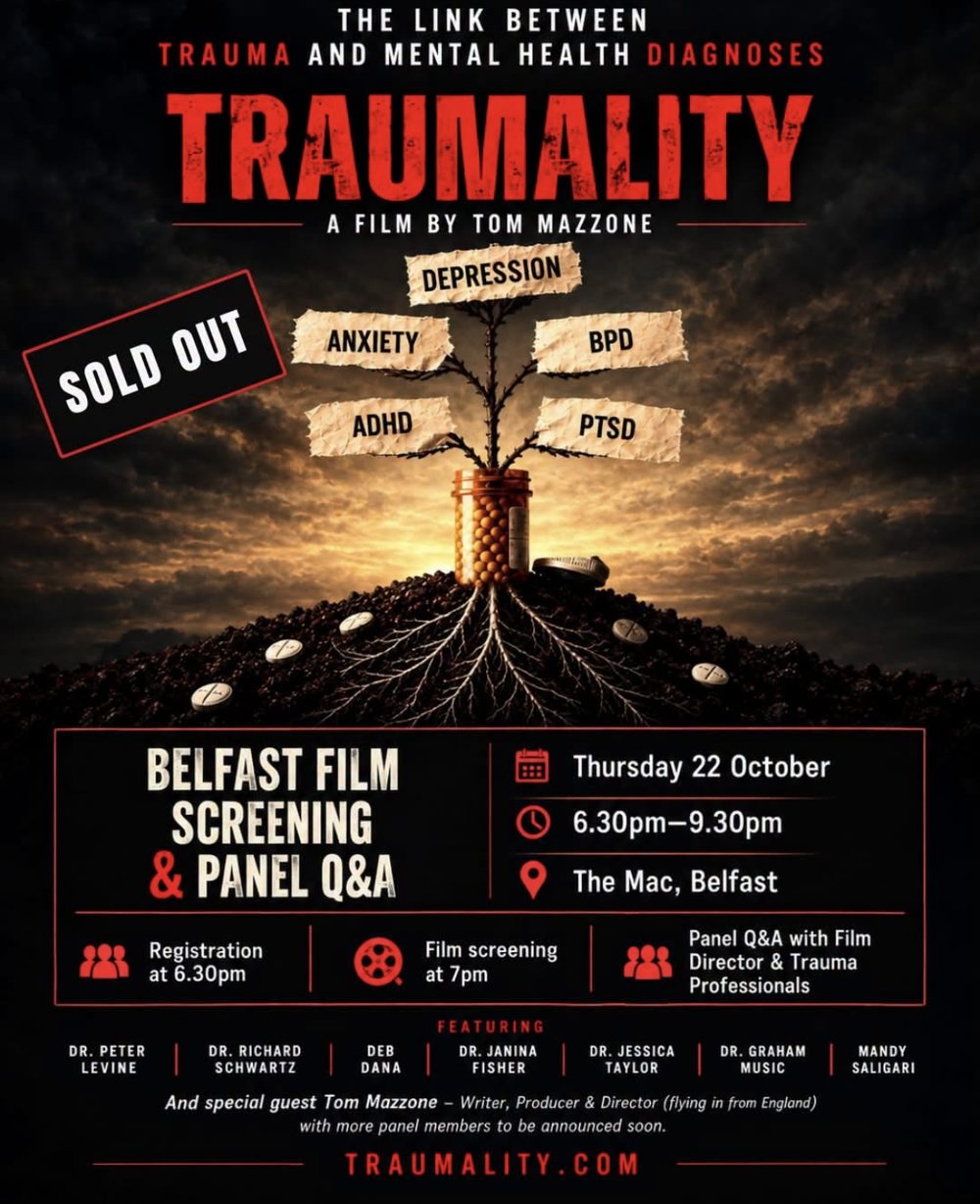
Last night I sat in the MAC for the Northern Ireland premiere of Traumality, and I left with one question: how do we get everyone to see this?
A film made for the person who asked for help
Traumality is a feature documentary by British filmmaker Ton Mazzone. Throughout his twenties he struggled with his mental health. When he finally went to his GP, he was told he had a disorder and needed medication to feel better.
That explanation didn’t bring him relief. It brought shame. He walked away believing something was fundamentally wrong with him, while a quieter part of him knew that couldn’t be the whole story.
Years later he learned about trauma, and his life started to make sense. He wasn’t broken. There were reasons he felt and reacted the way he did. So he made the film he wishes he’d been shown the day he first asked for help.
What the film asks of us
Traumality brings together people whose work has shaped how many of us practise: Dr Peter Levine, Dr Richard Schwartz, Dr Janina Fisher, Deb Dana, Dr Jessica Taylor, Dr Graham Music and Dr Suzanne Zeedyk among them, alongside people sharing their own experience of the system.
Together they ask why our mental health system is still so rooted in a medical model. And they ask what it would look like to understand people not by what’s wrong with them, but by what’s happened to them.
It’s not about what’s wrong with you, but what happened to you.
That shift matters. When we look honestly at what people have faced (the adversity, the losses, the challenges) and at the absence of the right support, compassion and guidance along the way, a different picture appears. Not one of flaws and disorders, but of a nervous system that found ways to cope.
Those coping strategies made sense at the time. Many of them kept us safe. Some of them simply no longer serve us. That isn’t brokenness. It’s adaptation.
Why I keep posting
Watching the film reinforced something I wrestle with regularly. I’m not a social media influencer, and I have no wish to become one. There are days I question why I keep putting content out there at all.
The answer is simple. If those of us trained in trauma-informed practice stay quiet, the space doesn’t stay empty. It gets filled, often by people with no mental health training, sharing information that is incomplete or simply wrong. And people absorb it. They build their understanding of themselves on it.
So I post to offer correct information. Not to convince anyone. I can’t convince you of anything, and it isn’t my job to try.
What I can do is put a different lens in front of you. What you do with it is yours. That’s the part only we can do for ourselves: staying open, staying curious, and asking, does what I’ve been told actually fit with what I now know? Do I need to make room for something new?
We are never stuck
This is the hopeful part, and the film carries it too. Our brains and bodies can change throughout our lives. We can heal through new information, new embodied experiences and new ways of being.
We are never stuck. But we do need a toolbox to recover, and we build that toolbox through connection: with people who meet us with compassion and curiosity rather than control, force or judgement.
Watch it
If you can, watch Traumality. Watch it if you’ve ever felt broken, if you love someone who’s struggling, or if you work with people in any capacity. Then talk about it.
You can rent the film for seven days, and organisations can license it for their own screenings.
Poster image: Traumality Belfast screening and panel Q&A at the MAC, 22 October 2026. Film by Ton Mazzone, traumality.com.